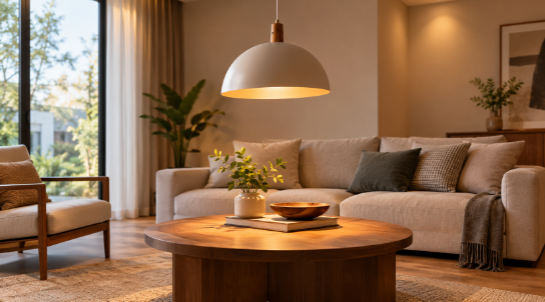
A living room usually gets judged in the first ten seconds — and lighting decides most of that impression. A well-chosen hanging light does more than illuminate the room; it sets the mood, draws the eye to the right spot, and ties the furniture, walls and décor together. Choose poorly, and even a beautifully furnished room can feel flat or oddly lit.
If you're looking at hanging lights for living room in Coimbatore, the choice isn't one-size-fits-all. Homes here range from compact apartments to independent houses with high ceilings, and interior styles swing between minimal, traditional and contemporary. What works for a double-height hall in a villa won't necessarily suit a cosy 10x12 living room in an apartment. Room size, ceiling height, furniture layout, design preference, brightness needs and colour temperature all play a part in getting it right.
Why Hanging Lights Work Well in Modern Living Rooms
Hanging lights, or pendant lights, sit lower than the ceiling, which naturally makes them more noticeable than flush-mounted fixtures. This is exactly why they're effective as a design statement a single striking pendant over a centre table can anchor the whole room, while a row of smaller ones can add rhythm above a console or seating nook. They also let you direct light more precisely than a ceiling-mounted panel, which matters when you want a seating area to feel warm and intimate rather than flatly lit.
Types of Hanging Lights for Living Rooms
Cluster Hanging Lights
A cluster arrangement groups several small pendants at different heights, usually over a centre table or an open corner. It suits contemporary and eclectic interiors and works well as a focal point in double-height or high-ceiling spaces, where a single fixture might look lost.
Dome Hanging Lights
Dome-shaped shades direct light downward, giving a focused, warm pool of illumination. They pair naturally with mid-century or classic interiors and are a practical choice above a centre table where you want usable light rather than just ambience.
Conical Hanging Lights
Conical or cone-shaped fixtures taper towards the base and give a slightly more contemporary, angular look than a dome. They suit modern living rooms and work well when hung at a consistent height in twos or threes.
Drum Hanging Lights
Drum shades diffuse light more softly and evenly across a room, making them a good fit for general ambient lighting rather than a sharp focal point. They tend to suit transitional interiors — spaces that mix traditional furniture with modern finishes.
Geometric Hanging Lights
Angular, faceted or wire-frame designs fall into this category. They photograph well and make a strong style statement, but they can visually compete with an already busy room, so they suit relatively simple, neutral interiors better.
Globe Hanging Lights
Spherical shades — in glass, metal mesh or fabric — give an even glow and a softer silhouette than geometric designs. Globe lights work well in pairs or small clusters and suit both modern and slightly retro interiors.
Other Decorative Hanging Light Styles
Teardrop and cylindrical hanging lights offer a more understated, elongated profile that suits narrower spaces or spots where you don't want a large silhouette. Novelty hanging lights — shaped or artistic designs — work as accent pieces in a single feature spot rather than throughout the room, since more than one novelty fixture can start to feel cluttered.
How to Choose the Right Hanging Light for Your Living Room
Consider Room Size and Ceiling Height
In a compact living room, an oversized fixture can dominate the space and make the ceiling feel lower than it is. Conversely, a small pendant in a large, high-ceilinged hall can look undersized and get visually lost. As a general starting point, larger rooms and higher ceilings can carry bigger or clustered fixtures, while smaller rooms are usually better served by one moderately sized pendant or a slim design.
Choose the Right Fixture Size
It helps to think in terms of the table or seating area below the light, not just the room as a whole. A fixture that's roughly proportionate to the table beneath it — not wider than the tabletop, not so small it looks like an afterthought — tends to look the most balanced.
Select the Right Colour Temperature
Warm white (around 2700K–3000K) gives a cosy, relaxed feel and is common in Indian living rooms. Neutral white (around 3500K–4000K) is more balanced and works well if the room also does double duty as a reading or work space. Cool white (4000K and above) feels brighter and more energetic, but it isn't always the right choice for a room meant to feel relaxed — it depends entirely on how the space is used and the rest of the interior palette.
Match the Light With Your Interior Style
A fixture should complement the furniture and wall finishes, not compete with them. In a room with bold upholstery or a patterned accent wall, a simpler pendant usually works better than another decorative statement piece.
Think About Brightness and Light Distribution
One hanging light rarely lights an entire living room well on its own — it's usually meant to provide focused or accent light over a specific area, while ambient lighting comes from elsewhere in the room. Wattage, bulb type and beam angle all affect how far the light spreads and how concentrated it feels underneath.
Where to Place Hanging Lights in a Living Room
Hanging lights work best where they add focus without getting in the way. Good spots include above a centre or coffee table, near a defined seating cluster, at the transition point in an open-plan living-dining layout, or as a standalone accent near an entryway.
They're less effective — and can actually be a problem — directly above a sofa or in the path of movement, since low-hung fixtures at head height create both a glare risk and a practical obstruction. Lamps that hang over couch seating should generally be positioned to the side or behind the sitting line, not directly above where people's heads would be.
How Hanging Lights Work With Other Living Room Lighting
A living room reads best with layered lighting rather than a single source. Ambient lighting fills the room generally (ceiling lights, recessed lights), task lighting supports specific activities (reading, working), and accent lighting highlights a feature — this is usually where a pendant fits in. Hanging lights pair well with recessed spotlights for general fill, wall mounted lamps for living room seating corners, and floor lamps for reading spots. LED strip lighting along a false ceiling or shelf can add a soft background glow that keeps the pendant from being the only source in the room after dark.
Hanging Lamps for Dining Room: What to Consider
Hanging lamps for dining room use differ from living room pendants in a few practical ways. Dining fixtures are usually hung lower and more centrally, directly above the table, because the goal is even, focused light across the eating surface rather than ambience across a wider area. Table size also matters more directly here — the fixture (or a row of them) typically needs to span a good portion of the table's length without overwhelming it, and clearance above head height still needs to be maintained for anyone standing at the table's edge.
Where to Explore Hanging Lights for Living Room in Coimbatore
Mayur Lights has been part of Coimbatore's lighting landscape since 1982, working as a lighting manufacturer and showroom that also offers consultancy support for residential lighting requirements. For homeowners weighing up hanging light styles, colour temperatures and placement for their living room, having a local showroom to see fixtures in person — and talk through what suits a specific room — makes the decision easier than choosing from photos alone.
Explore Mayur Lights or speak with the team to find a hanging light that suits your space, style and lighting requirements.
Frequently Asked Questions
Conclusion
Getting hanging lights right for a living room is less about finding a single "correct" fixture and more about matching type, size, height and colour temperature to your specific room and the way you use it. Take stock of your ceiling height, furniture layout and the mood you want before you shop, and treat the pendant as one part of a layered lighting plan rather than the room's only light source. If you'd like to see options in person, Mayur Lights' Coimbatore showroom is a reasonable place to start, and their team can help you think through what will actually work in your space.
About the Author
Mayur Lights is a Coimbatore-based lighting brand providing lighting solutions for residential and commercial spaces. The content is created to help readers make informed lighting decisions based on room requirements, design preferences and practical lighting considerations.
Ready to Find the Right Hanging Light?
Visit the Mayur Lights Avinashi Road showroom to see fixtures in person and get guidance suited to your living room.
Contact Mayur Lights